
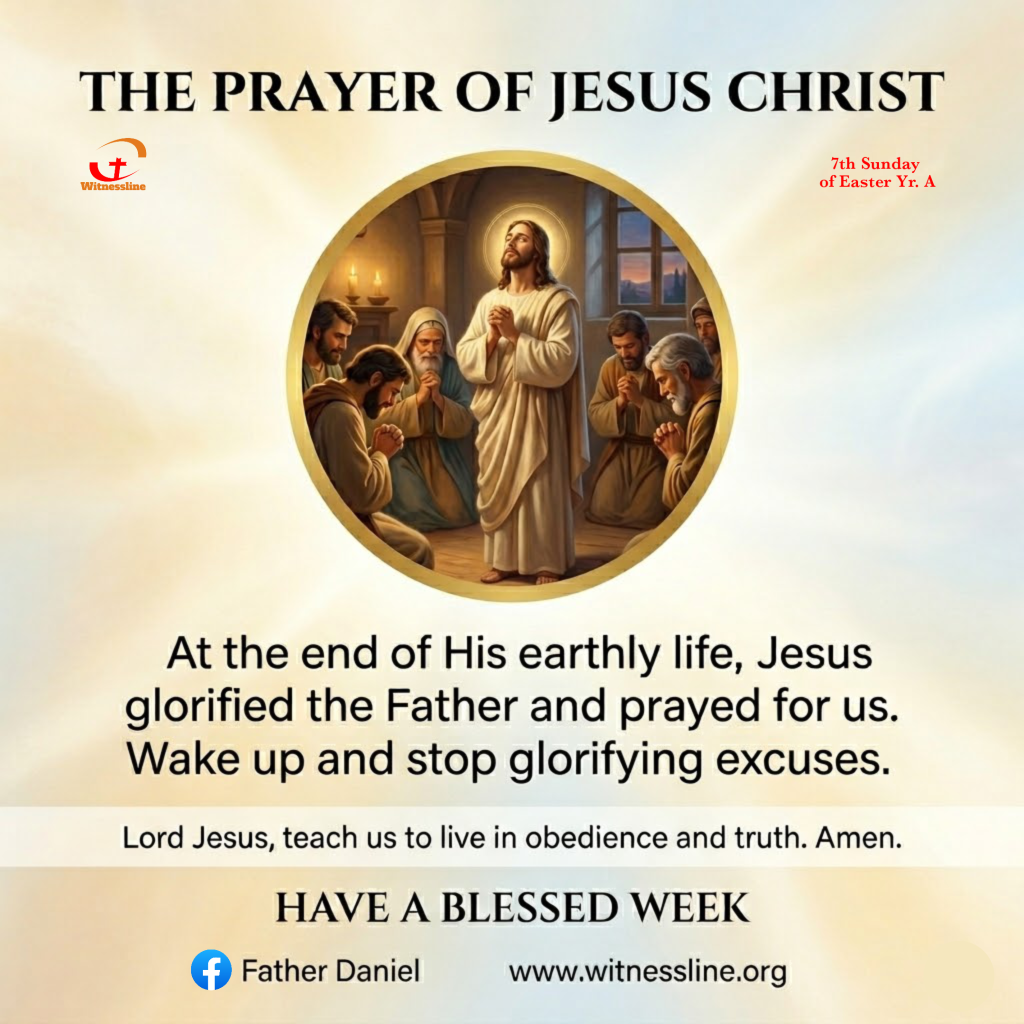
THE PRAYERS OF JESUS CHRIST
ACTS 1:12-14, PSALM 27, 1 PETER 4:13-16 , JOHN 17:1-11
Rev. Fr. Daniel Evbotokhai
JESUS, THE MAN OF PRAYER: John chapter 17 presents the beautiful and profound prayer of Jesus Christ. The fifth-century theologian Clement of Alexandria described this prayer as the action of Christ as the High Priest interceding for His people. It is rightly called the “High Priestly Prayer of Jesus.” But this is not an isolated moment. It reveals a pattern that runs through the entire life of Christ:
- At His baptism, Jesus prayed (Luke 3:21)
He withdrew often to pray in solitude (Luke 5:16)
He spent the whole night in prayer before choosing the apostles (Luke 6:12)
He prayed at the Transfiguration (Luke 9:29)
He taught the disciples how to pray (Matthew 6:9–13; Luke 11:1–4)
He prayed even for children to be blessed (Matthew 19:13)
Beloved in Christ, if Jesus prayed, then prayer is not optional for us. It is essential. A Christian who does not pray is spiritually disconnected. Many today pray only when there is trouble. But there is a saying: If you only pray when you are in trouble, you are already in trouble. Today’s readings therefore invite us back to the school of prayer. Acts 1:14 tells us that the apostles “devoted themselves with one accord to prayer.” Yet in our time, many Christians are more engaged in playing than praying, more connected to media than to God. May the Lord restore in us the spirit of true devotion.
PRAYER AS INTIMACY WITH THE FATHER (JOHN 17:1–5): The first section of John 17 reveals the deepest dimension of prayer: relationship. Jesus addresses God as “Father,” revealing divine intimacy. Prayer is not merely asking; it is entering into communion with God. Prayer is conversation with God, relationship with the Father and participation in divine intimacy
Through Christ, we are brought into this same relationship. He opens the door for us to call God “Father.” However, intimacy must not lead to irreverence. Today, many have become too casual with God. Some use God’s name carelessly, others reduce God to an instrument of personal desires and some even elevate themselves above reverence
But Jesus shows us the correct posture: He seeks glory, not for Himself alone, but so that the Father may be glorified. If our prayer does not glorify God, then something else is being glorified in our lives. True prayer leads to humility, gratitude, and reverence.
PRAYER FOR THE DISCIPLES: DIVINE PROTECTION (JOHN 17:6–11) In the second movement of the prayer, Jesus intercedes for His disciples. This reveals the pastoral heart of Christ. Jesus does not pray that they be removed from the world, but that they be kept in the world. This “keeping” includes four dimensions:
a. Eternal Security: Jesus prays that their faith will endure. Despite trials, persecution, and suffering, they will not be lost.
b. Joy in Opposition: Jesus acknowledges that the world will hate them. Yet He prays that their hearts will be filled with joy even in suffering. This connects with 1 Peter 4:13–16: “If you suffer for the name of Christ, you are blessed.” Suffering for Christ is not a curse; it is participation in His glory.
c. Protection from the Evil One: Jesus clearly says: “I do not ask that You take them out of the world, but that You keep them from the evil one.” This is a spiritual battle. The Christian life is not free from attack, but it is covered by divine protection.
d. Sanctification in Truth: The final dimension is holiness. This is not external religious display but interior transformation. True sanctification means purified heart, renewed mind, and consistent life of truth. Not Pharisaic appearance, but authentic holiness.
THE CHURCH IN PRAYER: UNITY AND EXPECTATION (ACTS 1:12–14) After the Ascension, the apostles return to the upper room. They are united in prayer with Mary, the Mother of Jesus. This reveals that prayer builds unity, sustains waiting and prepares for the Holy Spirit. They did not scatter in fear; they gathered in faith. Where there is prayer, there is unity. Where there is unity, the Spirit descends.
PRAYER IN SUFFERING: A SIGN OF GLORY (1 PETER 4:13–16) Peter reminds us that suffering for Christ is not shameful but glorious. The Christian is not exempt from suffering, but transformed through it. Do not be ashamed of your faith, do not abandon prayer in trials and do not interpret suffering as abandonment. If Christ, the Son of God, found time to pray, how much more must we? Let us return to prayer: not occasional prayer, but consistent prayer; not emotional prayer only, but spiritual discipline; and not selfish prayer, but God-glorifying prayer
Prayer:
May the Lord teach us to pray again.
May He keep us from the evil one.
May He sanctify us in truth.
And may our lives give glory to the Father.
Amen.
