
Rev. Fr. Daniel Evbotokhai
Some spoke without interpretation, others spoke simultaneously, and worship became confusing rather than edifying. This led St. Paul to provide what may be described as a structured regulation of the gift.
The practice of speaking in tongues has become one of the trendiest expressions of charismatic Christianity today. While it is often associated with spiritual fervor and prayerfulness, it has also generated mystification, misunderstanding, and in some cases, disorder in worship. In fact, some are even speaking in tongues but cannot speak in truth; we admire charisma but neglect character. So, we are becoming a generation of multiple spiritual activities but little or no spiritual transformation. We even fear the desired transformation because of its demands on our lifestyle, choices and comfort. Recall that, when spiritual expression is detached from moral integrity, it loses its authenticity and becomes mere performance. In the same vein, when speaking in tongues is removed from its context and realm; it breeds abuses and disorder in worship.
 Speaking in tongues is not appropriate anywhere except in prayers, yet we do occasionally hear certain preposterous expressions. It has become the daily communal language for some people. While some use it as exclamation, others use it to express revelation. Some preachers often interrupt their sermons or messages by speaking in tongues intermittently. For some, it becomes the only available expression where words are lacking. This begs the question. How can one claim to be spiritual yet perpetually engage in abusing the person of the Holy Spirit and his gratuitous gift?
This article seeks to revisit an article I published in this paper (May Edition, 2025) titled “Speaking in Tongues: Decorum vs Distraction.” Being that we have just celebrated another Pentecost, there is need to draw our minds once again to this growing “tongues trend” that many are increasingly imbibing without proper discernment. Therefore, this article presents us with the teaching of St. Paul in 1 Corinthians 12-14, as a kind of “constitution” governing the proper use of the gift of tongues within Christian worship. The use of the word “constitution” here is intentional: just as a constitution provides structure, limits, and order to a society, so St. Paul provides clear spiritual guidelines to ensure that charismatic gifts build up, rather than divide, the Church.
The first major biblical reference to speaking in tongues is found in Acts 2, on the day of Pentecost. There, the Apostles, filled with the Holy Spirit, spoke in different languages understood by people from various nations. The purpose was clear: the proclamation of the Gospel and the unity of peoples.
However, in 1 Corinthians 12-14, St. Paul addresses a different situation. In the Corinthian Church, the gift of tongues was being used in a way that created disorder in the liturgical assembly. Some spoke without interpretation, others spoke simultaneously, and worship became confusing rather than edifying. This led St. Paul to provide what may be described as a structured regulation of the gift.
Speaking in tongues is understood in Catholic theology as a charism, a free gift of the Holy Spirit given for the building up of the Church. It is not a learned language, nor is it a required sign of holiness. In Catechism, it is often associated with “glossolalia,” a form of prayer expressed in spontaneous vocal sounds that may not correspond to recognizable human language. The Catholic Church does not reject such expressions but insists that they must be discerned and properly ordered within the life of the Church. What is essential is not the external form, but the spiritual fruit: faith, humility, love, and unity. Hence, St. Paul offers clear guidelines for the use of tongues in the liturgical assembly. These can be summarized as follows:
- Order and Limitation in Public Worship: “No more than two or three should speak in tongues…” (1 Cor. 14:27). Paul emphasizes that spiritual gifts must not overwhelm the liturgy. Order is essential for meaningful worship.
- The Necessity of Interpretation: Tongues spoken publicly must be interpreted so that the entire community is edified. Without interpretation, the gift loses its communal purpose and becomes unintelligible.
- Silence When Necessary: “If there is no interpreter, the speaker should keep quiet in the Church…” (1 Cor. 14:28). This instruction shows that silence can also be an act of obedience and spiritual maturity.
- Private Prayer is permitted: St. Paul acknowledges that speaking in tongues may have a place in personal prayer life. However, private devotion must not be confused with public liturgical norms.
In 1 Corinthians 13, St. Paul places all spiritual gifts under the primacy of love: “If I speak in the tongues of men and of angels but have no love, I am nothing.” This is a critical theological point. No charismatic gift, including tongues, has value if it is not rooted in love. Love is the foundation of all spiritual gifts, the measure of authenticity and the goal of Christian life. Without love, spiritual expression becomes empty noise.
St. Paul concludes his teaching with a foundational principle: “Let all things be done decently and in order.” (1 Cor. 14:40). This statement is central to Catholic understanding of worship. The Holy Spirit does not produce confusion. Instead, He brings peace, unity, and clarity. Where disorder replaces reverence, discernment is required. Where personal display replaces communal edification, correction becomes necessary.
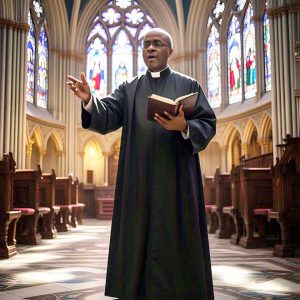 The Catholic Church affirms the presence of charismatic gifts but insists on discernment. Speaking in tongues is not required for salvation; it is not proof of spiritual superiority; it is not the highest form of prayer and it is not to be used without order and interpretation in public worship. Every gift must serve the unity and mission of the Church. Priests and ministers are therefore called to guide the faithful so that charismatic expressions remain authentic and spiritually fruitful.
Conclusively, St. Paul’s teaching on speaking in tongues functions as a spiritual “constitution” for the proper use of charismatic gifts in the Church. It does not suppress the Holy Spirit but safeguards His authentic action within the body of Christ. The true measure of any spiritual gift is not its outward expression, but its fruit. When properly understood and exercised, speaking in tongues can enrich personal prayer life. However, when detached from order and love, it risks becoming confusion rather than communion. In the end, St. Paul’s message remains clear and timeless “God is not a God of disorder but of peace” (1 Cor. 14:33).
