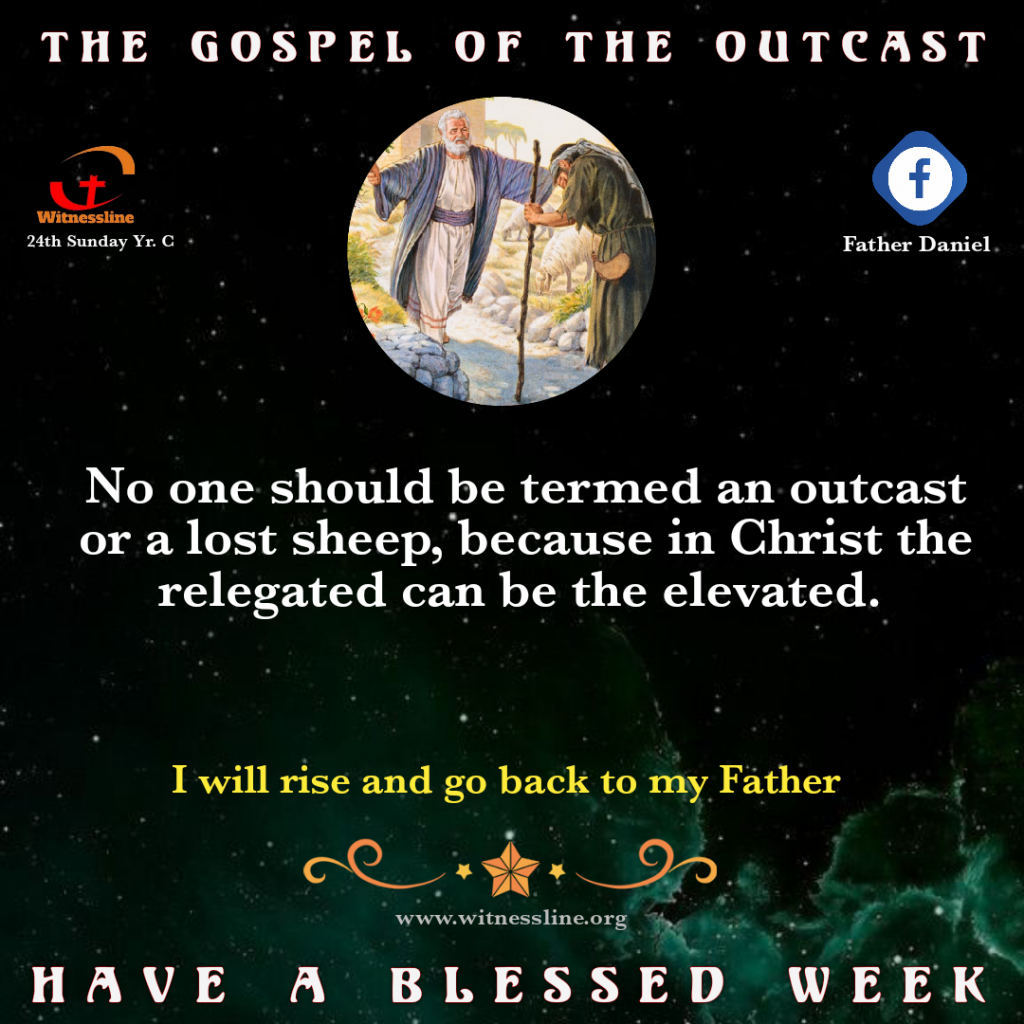
EXODUS 32:7-11, 13-14/PSALM: 50(51):3-4, 12-13, 17, 19/ 1 TIMOTHY 1:12-17/ LUKE 15:1-32
Fr. Daniel Evbotokhai
The Gospel of the Outcast
Luke 15 has been called “The Gospel of the Outcast” This chapter is God’s message to those who have strayed or wandered far away from God. It is also a message of restoration for those who might be constrained by a troubling sin. Outcasts are individuals who have been condemned by the society as failures. They include those who feel rejected by God because of a moral or spiritual failure. Using the parables of the Lost Sheep, the Lost Coin and the Lost Son; Christ presents us with a message of restoration and hope for lapsed and fallen believers. Let us look at each of these parables.
The Lost Sheep: Like the lost sheep we all have the tendencies to stray away from the right path, to seek the pastures that are not good. Isaiah 53:6 says “We all like sheep have gone astray, each one has turned to his own way; and the Lord has laid on Him the iniquity of us all.” In our journey through life we all risk getting lost in doctrine or morals; we tend to seek greener pastures and by so doing miss our way. Some are lost today because they needed greener pastures; extra power, wealth and fame. Nevertheless, do not condemn those that have gone astray. We all have similar tendencies; some of us may be morally sound but spiritually lost; some may be intellectually sound but morally lost; some can be intelligent but without character. You may always receive Holy Communion but communally lost. Therefore, condemn no one.
Like the Good shepherd and the woman that went in search of their lost sheep and coin respectively. Parents, teachers, and guardians should not give up on their children, search until you find them. Other children may be very good like the 99 that did not stray, but for the sake of the lost one continue to steer up prayers, one day you shall rejoice. No one should be termed an outcast or a lost sheep, because in Christ the relegated can be the elevated. No child is beyond repair. Its only despair that says a child is beyond repair. In the mechanic site, no car part is a waste. If the car is so bad, they take off the chairs and use them as seats for customers or car owners.
The Lost Coin: It takes time and effort to find someone who is lost, especially someone who is spiritually lost. However, this parable shows that God’s love for all of His people is so enormous that He will never stop attempting to win the hearts of all those who have fallen away from Him. Every person who comes back to Him is a source for great joy. Luke 15:7 says “there is more joy in heaven over one lost sinner who repents…” God is willing to save us, come to him.
In the first reading, (Exod. 32:7-11) the Golden Calf episode, which involved Israel’s apostasy and revolt, is a famous example of human failure in the Old Testament. It also portrays a prime example of God’s mercy, who pardoned them in response to Moses’ appeal. In 1 Tim. 1:12-17 Paul serves as a concrete illustration of God’s mercy. The entirety of God’s approach to a sinful mankind is modeled on Paul. If God could forgive Paul, then we have the hope of restoration. The response to today’s psalm says “I will arise and go to my father”. Cast me not away from your presence O Lord.
The Prodigal Son: In the parable of the prodigal son or the lost son, the young man said; “Father I have sinned against heaven and before you”. Confession of sins is an essential part of reconciliation and restoration. The young man acknowledged his sins and resolved to return to the father. In the same vein, we all have to acknowledge our fault and confess it in order for us to be forgiven. In 2 Sam.12:1-13 When Nathan spoke to David, immediately David admitted his sins. In John 8:3-11 the woman caught in the very act of adultery did not begin to deny or argue or shift blames. We often shift blames like Adam; Gen 3:12 “And the man answered, “The woman whom You gave me, she gave me fruit from the tree, and I ate it.” Job referred to this later in his final appeal; he wondered in Job 31:33 if he had covered his transgressions like Adam by hiding his guilt in his heart. Prov. 28:13 warns; saying “He who conceals his sins will not prosper, but whoever confesses and renounces them will find mercy.”
No one should be termed an outcast; let him who have sinned, confess and be restored. Oftentimes you get to see people who don’t admit their faults. But the Church in her wisdom calls us to pray thus; “… through my fault, through my fault, and through my most grievous fault…” this repetition alongside the striking of breast is purposeful. We must admit and be conscious of our faults. If a sick man hides his sickness from the doctor his sickness will hide him. Don’t hide your sins. The gospel says the father ran towards him and immediately he was dressed up in robe. The robe is the symbol of new life. Anyone who goes to confession experiences this new life.
Fr. Paul Oredipe
“THE LOVE OF THE MERCIFUL FATHER”*
In the three parables of the today’s gospel we hear of the intrinsic nature of our God as Loving and Merciful Father. We hear of rejoicing and celebration three times – a feast.
As the readings in the liturgy today tell us: there is joy, indeed a celebration in heaven over one repentant sinner. God our Loving Father is ever ready and happy to welcome us whenever we come back to Him, just like the father of the prodigal son who called for celebration on the return of his son who was dead and has come back to life, the one who was lost and is found. And they began to celebrate.
This story is widely known in our Christian tradition as the parable of the prodigal son. A more appropriate title could be “the love of the merciful father”. The central figure in the story is the Father. It is the love of the father which sustains and prevails throughout the story, from the beginning to the end. Let us take a closer look together.
Out of selfishness and pride, the younger son demanded his inheritance. This is something outrageous and abominable. In the first place, to demand ones’ inheritance while the parents are still alive and active is a complete violation of prevailing custom and practice. Secondly, to demand and obtain this inheritance in advance of his elder brother is another violation of the natural order and principle. In spite of this, we are told “the father divided the property between them”. God is so generous (and even gratuitous) with His gifts. He gives in abundance. One of such gifts is freedom.
This younger son took his in his own hand and lavished and squandered it. In his distress and anguish, he remembered the abundance in his father’s house. “How many of my father’s paid servants have more food than they want, and here am I dying of hunger.” It is revealing to see that what actually effected the repentance and conversion in the heart of this prodigal son is the love and providence of the father. His own words show this: “I will leave this place and go to my father and say: I have sinned against heaven and against you, I no longer deserve to be called your son, treat me as one of your paid servants”.
His memory of home and his conviction that his father loves him cause the prodigal son to reflect and to decide to set out on the right road. As J. Escriva puts it: “Human life is in some way a constant returning to our Father’s house. We return through contrition, through the conversion of heart which means a desire to change, a firm decision to improve our life and which, therefore, is expressed in sacrifice and self-giving. We return to our Father’s house by means of that sacrament of pardon in which, by confessing our sins, we put on Jesus Christ again and become His brothers, members of God’s family”
Now we come to the elder son. He was so filled with his own righteousness and loyalty that he could not bring himself to say of his younger brother “MY” brother. We see again the love of the father. He “came out to plead with this elder son”. In this way, the father also forgave this son because he was so full of himself and never tasted the love of the father.
The father of the prodigal son is of course God Our Father. One telling detail in the story is that the Father does not wait for the repentant son to get all the way back before He forgives him. “While he was still a long way off, his father saw him and was moved with pity. He ran to the boy……” God moves towards us quicker than we move towards Him. He does not wait for our contrition to be perfect before His grace starts to draw us back, however sheepishly, to true repentance.
On his return journey, while a long way off, his father saw him, was moved with pity, ran to him, clasped him in his arms and kissed him tenderly. What an outpour of love and mercy. After the son’s act of contrition, the father’s only thought is to celebrate, that his son who was dead in sin has now been restored to life, the supernatural life of sanctifying grace. The son may have expected a stinging rebuke. But like the idolatrous Israelites in the wilderness, what he got was not wrath, but mercy and reconciliation. The festive banquet, the feast and celebration which immediately followed lifts the occasion to an even higher level of acceptance and forgiveness.
This story is not just a mere parable to illustrate an important lesson. It is our story, your story, my story. How often do we appreciate the free gifts of our loving Father? How do we even use that gift of freedom with which He continues to enrich our lives daily? Have we not often taken God’s unfailing pardon in our own lives for granted?
In the words of St. Paul: “Should we remain in sin so that grace may be given the more fully?” Out of the question!. We have died to sin; how could we go on living in it? (Rom. 6:1-2) In today’s second reading he said: “Here is a saying that you can rely on and nobody should doubt: that Christ Jesus came into the world to save sinners”.
In the gospel passage, one thing alone is sure and definite: NO SIN OF OURS IS GRATER THAN HIS LOVE. NO SIN OF OUR IS GREATER THAN THE LOVE OF GOD FOR US.
The Father of the prodigal son is FAITHFUL TO THIS FATHERHOOD, FAITHFUL TO THE LOVE that He had always lavished on his son. This fidelity is expressed in the parable, not only by his immediate readiness to welcome him home when he returns after having squandered his inheritance; it is expressed even more fully by that joy, that merrymaking for the squanderer after his return, merrymaking which is so generous that it provokes the opposition and hatred of the elder brother, who had never gone far away from his father and had never abandoned the home.
We have just said together in the responsorial psalm “It will leave this place and go to my father”. The prodigal son did not merely utter these words. He actually came back to confess and be forgiven. The challenge for us is this: do we have enough courage, are we humble enough and are we sincere enough today to approach this fatherly love and mercy of God?
Mercy is the form that love takes when the person loved is afflicted. God does not simply love; mercy is not simply a quality of his. He is Love; He is Mercy. All that He does is impregnated with the love and mercy that He is. In singing the praises of God’s mercies, the psalmists do not differentiate between the divine work of creation and the divine work of salvation. They seem to think of God having pity on each created being when yet in need of being called out of its nothingness.
The English word “mercy” is derived from the Latin misericors or misericordia which mean “compassionate of heart” or “compassionate heart.” To have compassion means to suffer with the sufferer and in this way to be moved to take away, or alleviate, the suffering of the other. God, of course, cannot suffer in His divine being, but His love for mankind was such that He was moved to send His only begotten Son to become man.
Jesus, though He is God, is able to suffer in his human nature and thus be compassionate, in the full sense of the word. Devotion to the Sacred Heart of Jesus now inspires us to sing songs of praise to the divine mercy enshrined in the heart of flesh, noblest of the organs of the body of our Savior.
We have the opportunity to experience this mercy in the Sacrament of Reconciliation. As the New Catechism reminds us:
”The whole power of the sacrament of Penance consists in restoring us to God’s grace, and joining us with him in an intimate friendship. Reconciliation with God is thus the purpose and effect of this sacrament. For those who receive the Sacrament of Penance with contrite hear and religious disposition, reconciliation is usually followed by peace and serenity of conscience with strong spiritual consolation. Indeed the Sacrament of Reconciliation with God brings about a true ‘spiritual resurrection’, restoration of the dignity and blessings of the life of the children of God, of which the most precious is friendship with God”. (CCC 1468)
While we still have time, let us run to God’s mercy, and if we do we shall discover the simple Gospel truth, that the Lord Himself is already running fast, to meet us. Let us find consolation in the gospel truth that for us men and for our salvation, Christ Our Lord suffered under Pontius Pilate, was crucified and died on the Cross. Thanks to that Cross, God’s mercy becomes public property, for all to see and all to share. “Far be it from me to glory except in the cross of our Lord Jesus Christ, by which the world has been crucified to me, and I to the world.”
The opportunity is regularly available and constantly provided. Of what use do we make of this? In fact how often do we remember it? If today you hear his voice, harden not your heart.
In the name of the Father and of the Son and the Holy Spirit. Amen