
Ezekiel 33:7-9/Psalms 95:1-2, 6-7, 8-9/Romans 13:8-10/Gospel: Matthew 18:15-20
“Towards a Christ-centred Approach to Conflict Resolution”
During my retreat with my classmates in preparation for our priestly ordination, the retreat director exhorted us to focus more on what would be going on at the Mass and to ensure that we never got distracted by thoughts of preparations and organisation for reception after Mass. According to him, even if everyone ate to the full that day someone would still go home and say, “he couldn’t even smile back” or “he just walked past me as if he didn’t know me”. Almost eight years as a priest, I am certain that there are people that I may have offended by my actions and inactions. The message is that it is normal that there be some misunderstanding, disagreement, wrongdoing, or conflict in any social group. The readings of today acknowledge this fact and remind us of our prophetic role as baptised Christians in fostering correction and reconciliation in love and charity following the example of Christ.
 The first reading (Ezekiel 33:7-9) addresses us in the person of Ezekiel. Like Ezekiel, we have been called to be watchmen and our task is to speak the mind of God, the truth about God and the will of God to the people of our time. Sadly, some people misunderstand the word prophet as a visionary, one who can tell the future. The reading speaks of correcting a person who is found to be doing wrong or going against God’s will so that the person could be helped to retrace their steps. The tone of the text is deontological, insisting that we are all responsible for one another as a matter of duty and obligation. The second reading (Rom. 13:8-10) takes up this call to responsibility and duty by asking us to be indebted to one another in love, in charity. He refers to it as a debt. If there is anything we really do owe another person, it is love and kindness. Precisely for this reason, St. Paul tells us that love is the fulfilment of the law.
Jesus himself admits of the possibility of conflict and error existing in a community. He therefore proposes certain steps to be taken to resolve such conflicts and misunderstanding. The first is a one-on-one dialogue with the brother or sister who has done wrong. Jesus’ way of putting it highlights the fact that dialogue is an act of speaking and listening. The next step is to involve two others as witnesses if the first step fails. Here Matthew highlights one of the goals of his gospel which is that Jesus is the New Moses, the Teacher of Righteousness. Jesus is portrayed as giving a new interpretation to Deuteronomy 19:15 by stating that the witnesses are not there to witness against one who has done wrong or to give a testimony as in a court or a tribunal; they are to witness to the reconciliation and ensure its realisation. Then, Jesus asks that the Church (ekklesia, assembly) be involved if the second step fails. In this way, Jesus recognises that conflict can also arise within the Christian community, and she must exercise her prophetic role of fraternal correction of wrongdoing and peaceful resolution of conflict.
An essential element therefore in conflict resolution is dialogue. The Church is to speak to wrongdoing; to listen and be listened to. This is to be done with the love of Christ in mind.
For the above reasons, Jesus assures us in the gospel that he will be with the Church, saying that where the assembly (two or three) is gathered in his name he is there. Matthew, thus, reiterates Jesus’ presence in the community of believers in the sense in which he is “God with us” and in the sense that he accompanies the Church in her mission, including that of peace and reconciliation (cf. Matthew 1:23; 28:20). This means that any attempt or approach to correcting wrongs or resolving conflict ought to involve Christ. Reconciliation, forgiveness and peace will easily take place if we approach it with the heart and mind of Christ; in love, in humility and openness to the truth. We do so by always recognising that the actual and real Head of the Church is Christ, and we are only its Members, constituting the Body.
 This immediately helps us to understand what Jesus means when he says, “if the wrongdoer refuses to listen to the Church treat him as you would a Gentile or a tax collector”. How did Jesus treat tax collectors? Alienate them? Cast them out? He welcomed them, showed them love by eating with them and passing time in their homes. Here the power of love and Christian charity becomes very evident. The very love that endures wrongs, misunderstandings and hurts patiently for the glory of God and for the good of others.
In the final analysis, it is Christ himself who makes the Church’s mission of reconciliation and conflict resolution achievable. We are thus to work with Christ through prayer and reflection. If Jesus says that whatever the Christian assembly binds on earth is considered bound in heaven, he is definitely pointing to the fact that it often takes a supernatural intervention to convert a person, correct wrongs and resolve conflict. We do this by getting heaven involved through prayer; we take these persons to Jesus who is present in the Blessed Sacrament and who is present in Eucharistic celebrations.
May the Blessed Virgin Mary, Mother of Good Counsel intercede for us and help us to learn how to bring offenders to Christ instead of keeping them away from the Christian community.
*******************
Fr. Daniel Evbotokhai
Fraternal Correction
The gospel speaks of the method the early Christians developed in order to deal with internal conflicts and with members who erred. It expresses the role of dialogue and the need for consensus at all times. The first and second readings continued with this theme. While Ezekiel says we must speak to the wicked to repent, Paul says love is the rule that must guide all our actions.
FRATERNAL CORRECTION: It refers to the act of correcting or admonishing someone, typically a friend or fellow member of a community, out of genuine concern for their well-being or moral development. The intent behind fraternal correction is not to criticize or condemn but to help the person recognize and rectify their actions or behavior when they have gone astray from ethical or moral principles. It is often seen as an act of love and support. Fraternal correction should be approached with care and sensitivity. ways we can express fraternal correction:
PRIVATE CONVERSATION: Address the issue in private to avoid embarrassment and allow for a more open and honest discussion. Jesus says in Matt. 18:15 (Today’s gospel), “If your brother does something wrong, go and point out his fault to him in private. If he listens to you, you have won back your brother.’ Some of like broadcasting to the world before coming to the individual. Again, in this private conversation we must equally choose the right time and place. Don’t initiate it when you are not in good moods.
LISTEN ACTIVELY: Give the other person an opportunity to respond and share their perspective. Listen attentively and empathetically. Don’t listen with the mind set of a lawyer, or searching for the best argument to flaw his views. Express some.level of compassion.
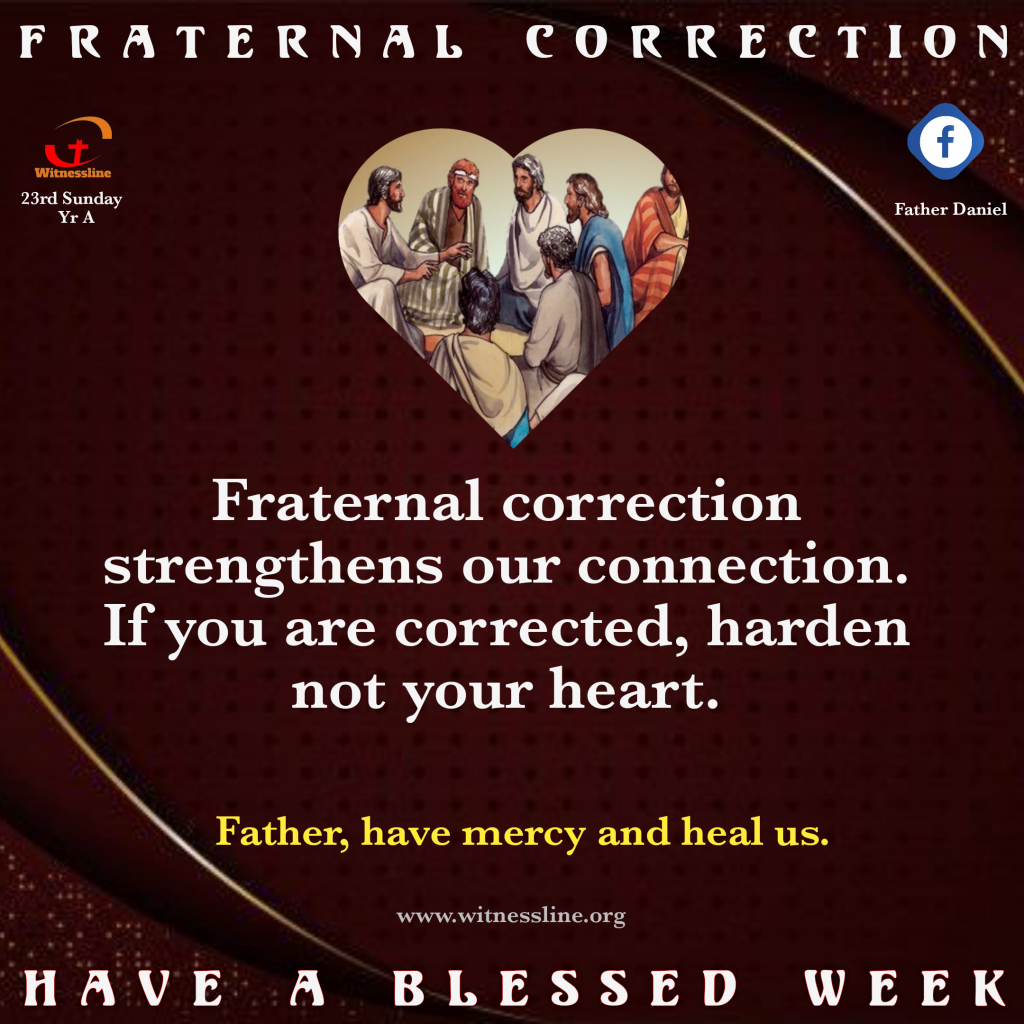
HAVE AN OPEN HEART: It is not always easy to deal with internal conflicts or any erring members of the Christian body. It is even more difficult in this relativistic time. In the face of this difficulty, Christians today must embrace fraternal correction in love. Fraternal correction strengthens our connection. If you are corrected, do not harden your heart (Paraphrasing today’s psalm). Some continue to reject correction at their own detriment. Misunderstanding is the widest gap between two people. Let’s close that gap by means of tolerance and understanding. We must understand our strengths and weaknesses and seek to help one another.
CORRECT IN LOVE: Ezekiel says if we do not correct the wicked we shall equally be held responsible for his sins (Ezek.33:8). We are to be responsible for one another. Are you concerned when a brother strays? Do you make sincere attempts at correcting a brother or a friend? Or what is your motive when you correct a brother? Is it to humiliate him or to expose his ignorance? St. Paul says in the second reading that love should be the reason for our actions. In 1 Corinthians 13:4–7 Paul brings out the complex nature of love. Love is patient. Am I patient with people? Love is kind. Am I kind to people? Love is not arrogant. Am I arrogant? Or what is my attitude towards correction? Love is not irritable. Am I irritated by instructions or advice? Love is not boastful. Am I boastful of my gifts and talent, and so listen to no one? Love does not rejoice in what is wrong.
INSTRUCT THE IGNORANT: It is the duty of every Christian to instruct the ignorant. Failure to do that leads to a conspiracy in sin that makes us as guilty as the primary victim. The spiritual work of mercy says “instruct the ignorant”, not destroy the ignorant. Where this has proven impossible, (the ignorant rejecting help) the first reading says the person shall die in his iniquity, and the gospel adds that the person should be treated as a sinner, and it will be ratified in heaven as such. These are the consequences of refusing correction. Anyone who refuses corrections ends in destruction. Many have died simply because they neglected correction. Homes are broken because corrections were neglected. Love, correct, and save your life.
PRAY ABOUT IT: The prophecy of Ezekiel and the statement of Christ about the end of those who refuse correction should provoke repentance. It is never the plan of God that anyone should be destroyed; for that reason, Christ calls us to pray. Beloved, let us not cease to pray for those whom we are correcting. Where words are limited, prayers can do the unlimited. Prayers give us deeper awareness of his presence and bring our conduct under divine influence. God bless you.
LET US PRAY
O God, by whom we are redeemed and receive adoption, look graciously upon your beloved sons and daughters, that those who believe in Christ may receive true freedom and an everlasting inheritance. Through our Lord Jesus Christ, your Son, who lives and reigns with you in the unity of the Holy Spirit, God, for ever and ever. Amen.
