
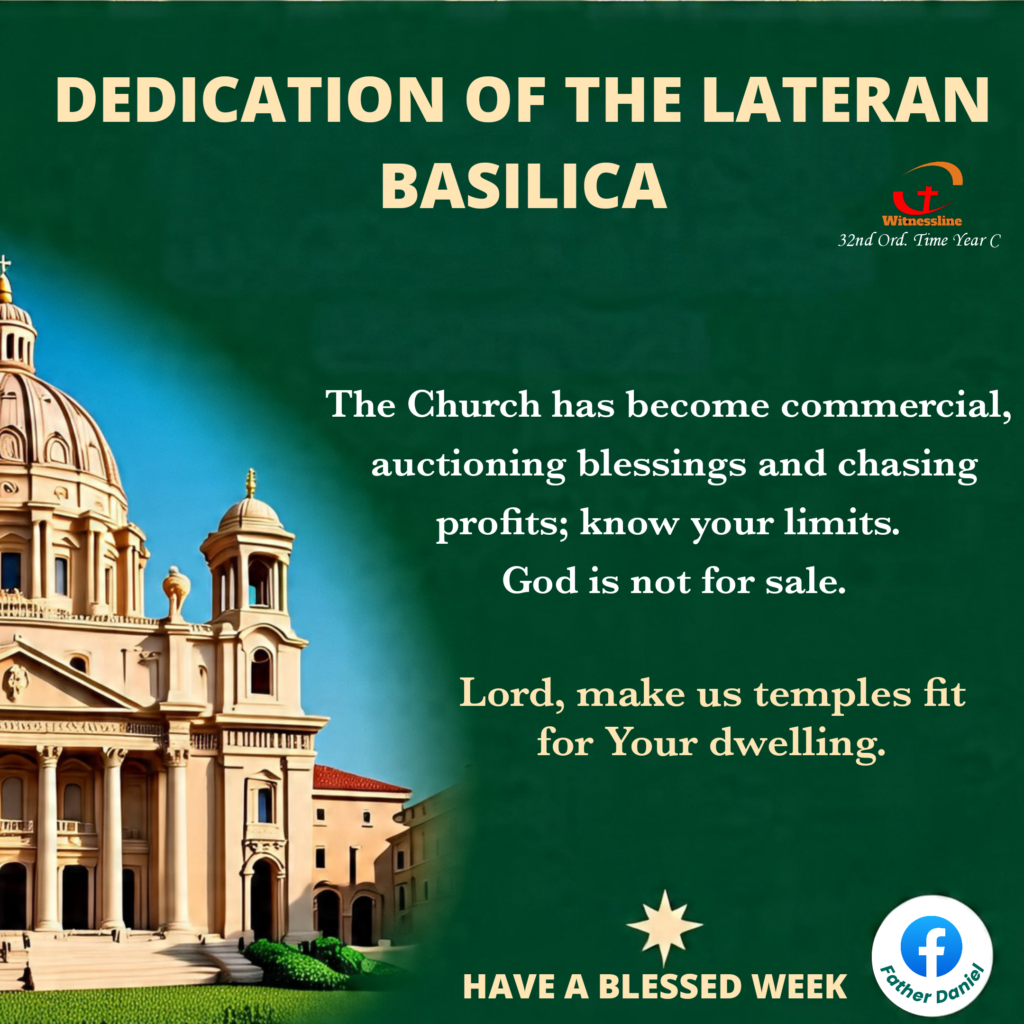
CLEANSING THE TRUE TEMPLE
Ezekiel 47:1–12; 1 Corinthians 3:9–17; Psalm 46; John 2:13–22;
In the Gospel (John 2:13–22), we encounter Jesus entering the Temple — not as a pilgrim, but as Lord. The Temple, the very dwelling place of God’s presence, had become corrupted by commerce. With divine zeal, Jesus overturns the tables, drives out the merchants, and declares, “Take these things out of here! Stop making my Father’s house a marketplace!”
This act was not mere outrage; it was a theological declaration— a sign that a new order of worship had begun. The old Temple, bound by ritual sacrifices and limited by location, was giving way to a new and living Temple — the Body of Christ (John 2:21). By cleansing the physical Temple, Jesus prefigured the cleansing of humanity, in whom God would now dwell through the Spirit. Thus, the Temple was no longer a building but a person — Christ Himself, and by extension, the Church, His mystical Body.
1. The Theology of the Temple: The Temple was the visible sign of God’s covenantal presence among His people. In the New Covenant, that presence is fully revealed in Christ — “The Word became flesh and dwelt among us” (John 1:14). The Greek word “dwelt” literally means “tabernacled.” Hence, in Christ, God pitches His tent among humanity. After His resurrection, this divine indwelling is extended through the Church, making her the universal Temple of the Holy Spirit (cf. 1 Cor 3:16–17). Every believer, by baptism, becomes a living stone (1 Pet 2:5) in this spiritual edifice. Therefore, to desecrate our bodies through sin or the Church through corruption is to repeat the scandal Jesus confronted in Jerusalem.
2. The Prophetic Cleansing: When Jesus purged the Temple, He was not abolishing Jewish worship but purifying it. His whip of cords symbolizes the authority of divine judgment and the necessity of interior conversion. The same Christ who cleansed the Temple calls us to cleanse our hearts. The Temple’s physical cleansing points to the sacrament of reconciliation, where the soul; God’s inner sanctuary, is restored to grace. Thus, the Church’s teaching on penance and purification finds a living echo in this passage: before divine worship can be authentic, the heart must be clean. External devotion without interior renewal is empty ritual.
3. The Church as the New Temple: St. Paul declares, “You are God’s building… you are the temple of the Holy Spirit.” (1 Cor. 3:9,16). The Church, born from the pierced side of Christ, is the continuation of His presence on earth. Her liturgy, sacraments, and doctrines are not commodities but sacred channels of grace. Yet today, many risk turning the Church into a commercial enterprise, selling access to the sacred, monetizing miracles, and reducing the holy to the profitable. When the sacred becomes commercial, faith becomes mechanical, and the altar becomes a counter. The modern Church must rediscover the reverence that Jesus demanded, not by rage, but by reform.
4. Zeal for God’s House: The disciples remembered, “Zeal for your house will consume me.” (John 2:17). True Christian zeal is not emotional frenzy but love aflame for God’s holiness. Every baptized person shares in Christ’s priestly mission to preserve the purity of the faith and the sanctity of worship. Silence in the face of sacrilege is complicity. The saints from Francis of Assisi to Catherine of Siena, all carried this consuming zeal that refused to watch the holy be defiled.
5. The Temple Within: If our bodies are temples of the Holy Spirit, then the cleansing must begin with us. Every sin greed, lust, pride, or unforgiveness; is a trader in our temple. Confession is not shame but cleansing; penance is not punishment but purification. Christ still enters the temple of every heart, overturning the tables of sin and calling us back to true worship.
6. The Eschatological Temple: The cleansing of the Temple also prefigures the final purification of creation — when the new heaven and new earth will become the eternal dwelling of God with humanity (Rev. 21:3). The Church’s liturgy on this feast reminds us that every consecrated building points forward to that eternal Temple, where the Lamb Himself will be our light and sanctuary.
This passage affirms three core Catholic truths:
1. The Real Presence of God — first in Christ, now in the Eucharist.
2. The Indwelling of the Spirit— making each baptized soul a living temple.
3. The Communion of Saints— all believers forming one holy Temple in Christ.
The Church must, therefore, guard the sanctity of her liturgy, her ministers, and her members — for when the sacred is abused, faith is endangered.
Today, many altars have become platforms of entertainment. The sacred has become commercial — auctioning blessings, selling “holy” items, and packaging grace like a product. If Jesus walked into some of our churches today, He would not smile; He would sweep. The Church needs reform, not marketing, repentance, not performance.
Prayer
Lord Jesus, cleanse your Church again. Drive out every spirit of pride, greed, and irreverence from your temple. Make our hearts your dwelling, our worship your delight, and our lives your glory. Amen.
Fr. Daniel Evbotokhai
