
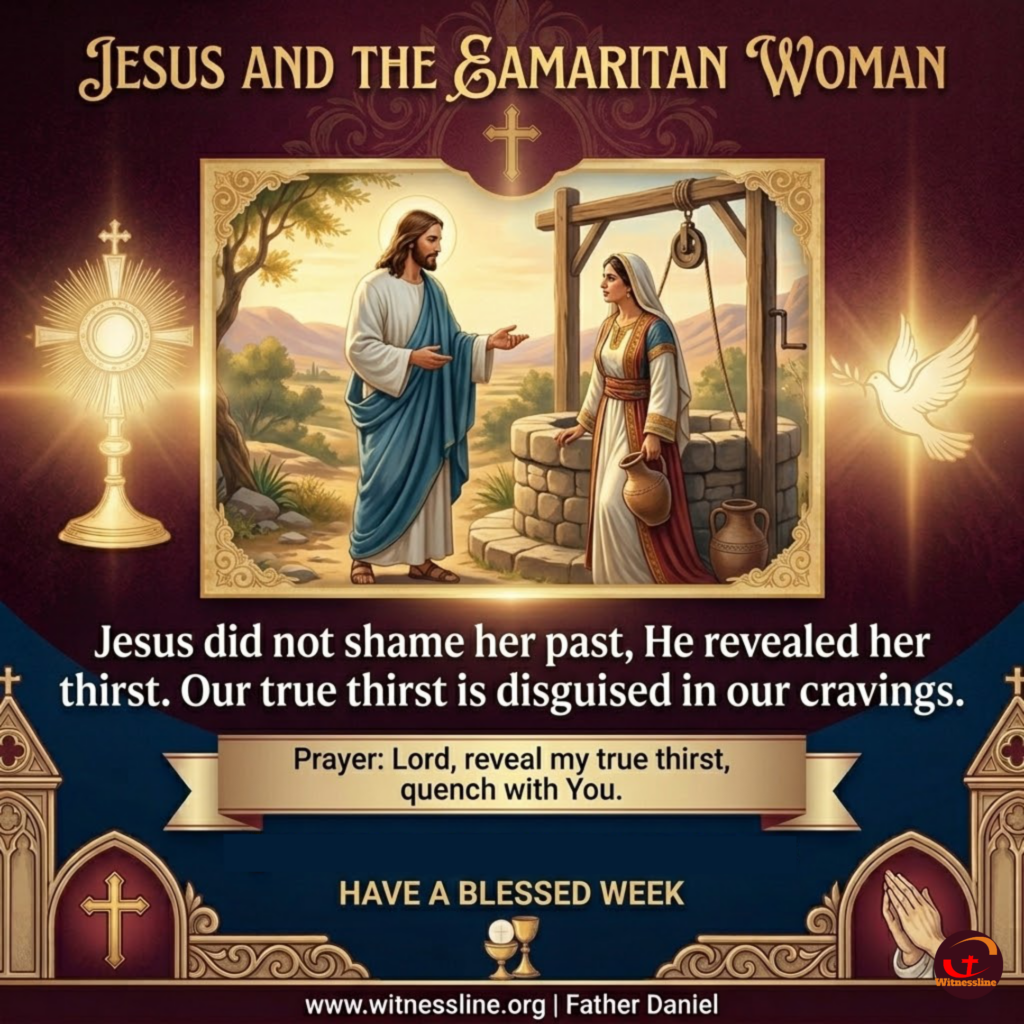
THE ENCOUNTER AT THE WELL
Fr. Daniel Evbotokhai
Exodus 17:3–7; Psalm 94; Romans 5:1–2, 5–8; Gospel of John 4:5–42
- The Human Thirst for God: We all need water; no man or woman can live without it. Hence it is often said that “water is life.” In the first reading from the Book of Exodus, the people of Israel were in desperate need of water during their journey through the desert. In their distress they complained against Moses and accused him of leading them to destruction. Yet, despite their murmuring, the Lord provided water for them. Human life itself is an exodus; a journey from slavery to freedom, from childhood to adulthood, from earth to heaven. Along this journey we often experience moments of dryness and fatigue: poverty, loneliness, suffering, hardship, and disappointment. At such moments we may ask, just as the Israelites did, “Is the Lord among us or not?” (Exodus 17:7). The truth is that God is always with us as the Fountain of Life and the Spring of Living Water.
- Jesus the Source of Living Water: In the Gospel, the Samaritan woman came to draw ordinary water, but Jesus Christ offered her Living Water. The expression “living water” appears in both the Old and New Testaments. In the Book of Jeremiah 2:13 and 17:13, God is described as “the fountain of living water.” Jesus also speaks of living water in John 4:10 and John 7:37-39, saying that whoever believes in Him will have rivers of living water flowing from within. Here Jesus refers to the Holy Spirit, the divine gift that brings new life to humanity. St. Cyril explains that just as water sustains all living things; nourishing plants, animals, and human life; so the Holy Spirit sustains spiritual life and works in many ways for the sanctification of the human person.
- “If You Knew the Gift of God”: Jesus said to the woman, “If you knew the gift of God” (John 4:10). These words are addressed to us today as well. If only we truly understood the gifts God has given us -the grace present in the Holy Eucharist, the mercy found in the Sacrament of Reconciliation, and the spiritual treasures available through the Church, we would not wander in spiritual emptiness. The prophet Hosea lamented, “My people perish for lack of knowledge” (Hosea 4:6). Many people continue to struggle spiritually because they do not fully appreciate the grace God has placed within their reach.
- The Human Void and the Search for Fulfillment: When the woman said, “I have no husband,” she expressed a deeper reality; a life marked by disappointment and longing. In truth, every human heart carries a certain emptiness. Many people attempt to fill this void with relationships, wealth, pleasure, power, alcohol, or other worldly distractions. Yet none of these can truly satisfy the human soul. St. Augustine captured this truth beautifully when he wrote: “You have made us for Yourself, O Lord, and our hearts are restless until they rest in You.” Only God, the Fountain of Life, can quench the deepest thirst of the human heart.
- God Meets Us in Our Authenticity: The Samaritan woman was open and honest before Christ. She did not hide her brokenness, and because of her sincerity, Christ revealed Himself to her. God meets us *not in our pretence but in our honesty. Often we hide behind appearances, and as a result we miss God’s grace. The Pharisees struggled spiritually because of their hypocrisy. True transformation begins when we present ourselves honestly before God. Because of the woman’s openness, Jesus revealed profound truths to her: God is Spirit. True worship must be in spirit and truth. Jesus is the Messiah. Jesus is the Savior of the world. Jesus came to seek and save the lost. These were deep mysteries of faith, yet they were revealed to a woman who was simply willing to learn.
- Encounter Leads to Spiritual Growth: Through this encounter, the woman gradually grew in her understanding of Jesus. Her perception of Him developed step by step: In John 4:9 she called Him a Jew. In verse 11 she addressed Him as Sir. In verse 19 she recognized Him as a prophet. In verse 29 she wondered if He might be the Christ. Finally, in verse 42 He was proclaimed the Saviour of the world. This shows that encounter deepens faith. Intellectual knowledge alone cannot fully explain God; a genuine encounter with Christ transforms understanding and strengthens belief. Interestingly, her encounter occurred in the well she visited daily for water. Your encounter can take place in a familiar environment not necessarily a mountain or a distant land. God can still visit you in the Church were you have worshipped for years. Don’t be too familiar with the sacred. Have a sacred consciousness.
- A Personal Encounter Leads to Mission: After encountering Jesus, the woman immediately became a witness. She left her water jar and ran to the town to proclaim what she had experienced. As the Gospel records, many people came to believe because of her testimony. She came alone but went back to reach out to everyone. A genuine encounter with Christ always leads to mission. Those who truly meet Christ cannot remain silent; they naturally become witnesses of the Good News. In Acts 4:20 the apostles exclaimed “We cannot remain silent about the things we have heard” This a powerful declaration of conviction, emphasizing the inability to keep quiet about truth, faith, or injustice. It represents a moral imperative to bear witness to experiences.
- Jesus Breaks Social and Religious Barriers: Jesus spoke to a Samaritan woman, something highly unusual in that culture. Jews avoided Samaritans, and rabbis rarely engaged women in public conversation. Yet Jesus crossed these barriers to bring salvation. This reminds us that God’s grace reaches beyond social, cultural, and religious boundaries.
Prayer: O God, author of every mercy and source of all goodness, who in fasting, prayer, and almsgiving have shown us a remedy for sin, look graciously upon this confession of our weakness. May we who are burdened by our sins be lifted up by Your mercy. Through our Lord Jesus Christ, Your Son, who lives and reigns with You in the unity of the Holy Spirit, one God, forever and ever. Amen.
