
ENLIGHTENMENT
1Samuel 16:6-7, 10-13; Psalm 22; Ephesians 5:8-14; John 9:1-41
The basic theme in today’s readings is light. The first reading (1Samuel 16) makes us to understand that whoever has not received the light judges things through human eyes; but God does not look at appearance but at the heart of man. The gospel reading was a narrative of how a blind man gained his sight. An invitation for us all to defeat darkness. There are some lessons from the healing of the blind man that will enlighten our minds.
1. SIN IS NOT THE NECESSARY CAUSE OF SICKNESS: Seeing a young man with no sight made the disciples wondered if it was as a result of sin. In response Jesus said this is not due to the sin of the parents or the boy but that God may be glorified. The Disciples thought was informed by some antecedents in scriptures; for instance: 1Cor.11:27-30 says because we eat unworthily we are sick; James 5:14-16 calls the sick to confess his sin and be healed; Ps.38:3 says my whole body is diseased because of my sins. But in Job 1:11-12 Job’s afflictions weren’t the result of sin even though his “friend” were insistent that Job’s sin was the cause. Ezekiel adds; “God does not delight in the death of his people; rather let him turn from his evil ways and live” (Ezk.18:23).
Today, there are some who believe that sickness is as a result of sin. The truth is that sickness doesn’t discriminate. It can hit anyone, regardless of their moral standing. Sometimes it’s just bad luck or a result of external factors (Genetics, environment, lifestyle choices, and sometimes just plain old fate). The Bible even talks about it in Job 2:7 and John 9:1-3. Therefore, while sickness and affliction are not necessarily as a result of sin. We must make every effort to turn away from sin so that we may gain eternal life.
2. NATURAL AND SUPERNATURAL HEALING: John describes the healing in a few short words.” Having said this, he spit on the ground, made some mud with the saliva, and put it on the man’s eyes. Could it be that Jesus had to use natural and divine power for this healing? Some point to the fact that saliva was thought to possess medicinal qualities in Hellenism and Judaism. Jesus himself uses saliva in two other healings as recorded in Mark7:33 the healing of a dumb man and in Mark8:23 the healing of a blind man. In both cases Jesus is not depicted as a physician resorting to natural medicines, but as a miracle-worker. The natural medicinal properties that might be in saliva were not believed by the people of Jesus’ day to cure a man born blind. In this sense, the Catholic Church recognizes two inclusive kinds of healing, one justified by science and one justified by faith:
1. HEALING By “NATURAL MEANS” through the practice of medicine which emphasizes that the theological virtue of charity demands that we not neglect natural means of healing people who are ill and the cardinal virtue of prudence forewarns not to employ a technique that has no scientific support. In this light, in the 2000, the Congregation for the Doctrine of the Faith issued an “Instruction on prayers for healing”. It accepts that there may be means of natural healing that have not yet been understood or recognized by science; but it rejects superstitious practices which are neither compatible with Christian teaching nor compatible with scientific evidence. This is so necessary especially now that many people including pastors are suggesting diabolic means for the cure of sicknesses.
2. HEALING BY DIVINE GRACE: This is intercession on behalf of the sick in the name of Jesus, through the power of the Holy Spirit, whether in the form of the sacramental laying on of hands and anointing with oil or of simple prayers for healing, which often include an appeal to the saints for their aid.
Both forms of healing are inclusive such that while we use our medications we can also pray for healing. Today, some Christians believe that while we pray for healing we should not apply medication. Faith is necessary for healing but we must never neglect good works James 2:17 says faith without good work is dead verse 22 says and by works faith was made perfect. When you pray for security you also need to lock your doors. Therefore, while the saliva may not have healing properties Jesus simply set us an example that medications are not sinful while we pray or that medication does not mean we lack faith.
OBEDIENCE AND HEALING: The gospel recorded that he went to the Pool of Siloam and washed off the mud and came home seeing. Jesus sought to have the blind man exercise his own faith in obedience. John indicates the derivation of the name Siloam as meaning “sent.” Perhaps he is making the point that the man was healed because he was “sent” to wash in the pool. He obeyed. In Luke 17:14 the healing of the ten lepers Jesus told them to go and show themselves to the priests. And the Bible says “and as they went, they were cleansed”. Again, in 2 Kings 5 Naaman was told by the prophet Elisa to go and deep himself in the River Jordan seven times and so was his healing. Beloved in Christ, obedience is an expression of faith, you can’t claim to have faith and you are not obedient. Sometimes, some of us neglect the instruction we are given by our priests and expect something miracuolous to happen. A priest once said to his parishioner that approached him for deliverance to go say the “Our Father” before the Blessed Sacrament and the Parishioner left the Priest sad. Most times what we need for the miraculous to happen is not a prolonged prayer but a simple obedience in faith. A lot of Christians today, struggle with so much fasting and prayers what a simple obedience and faith can manifest. Even obedience to doctors’ prescription matters.
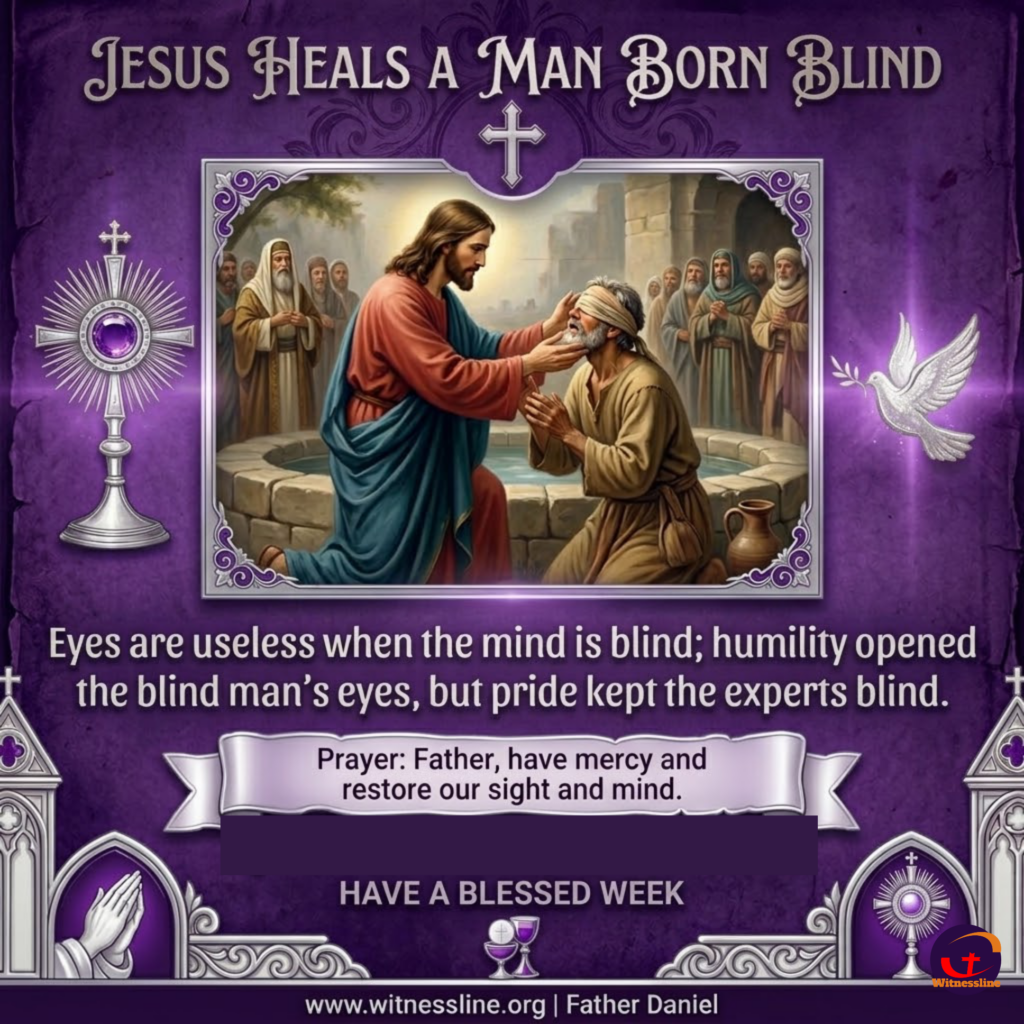
SPIRITUAL BLINDNESS: This gospel contains much argument between the Pharisees and the man who was healed; between the Pharisees and the parents of the man, lastly the Judgment passed by Jesus. John 9:39 Jesus said, ‘For judgment I have come into this world, so that the blind will see and those who see will become blind. The argument persisted in asmuchas the Pharisee remained spiritually blind. Humility healed the man, but pride blinded the eyes of the Pharisees.
The man could relate and beat their argument because of encounter. Encounter with the Lord opens our spiritual eyes. Encounter reduces arguments. Where understanding is limited encounter takes us further. It perfects our understanding. This man could explain all the more and even more logically because he had an encounter that has turned his life for better. Thus, he progressed in understanding to the point of worship. The gospel says in John 9:38 he prostrates himself before him in an act of worship.
Today, spiritual blindness means that we are in the church but we lack encounter with the Lord. Therefore, all that is said and explained make no meaning to us. Spiritual blindness can be caused by the devil 2 Cor.4:4 “The god of this age has blinded the minds of unbelievers, so that they cannot see the light of the gospel of the glory of Christ, who is the image of God.” and by our hard hearts John 9:41 “If you were blind, you would not be guilty of sin; but now that you claim you can see, your guilt remains.” It is my prayer that during this Lenten season God will open our eyes to see Him and worship Him in spirit and in truth.
We can go all the way to talk about other kinds of blindness:
Physical blindness, for example the man of today’s gospel that was born blind. We pray for those who suffer physical blindness, may their eyes be open through Christ our Lord.
Religious blindness ; A form of blindness that results from the biases of our faith. Like the degree of blindness that overcame the Pharisees, leading to their bigotry. Religious blindness is the cause of many ills carried out in the name of religion today.
Intellectual blindness; Lack of understanding of life’s purposes, false beliefs about reality, and general ignorance are all issues.
Today is rejoicing Sunday, we we are glad that Jesus the light of the world has come to enlighten our minds and hearts.
Mothering Sunday
Today is also Mothering Sunday, is different from mother’s Day. Let me open your eyes, Mothering Sunday is not the same as Mother’s Day, even though today many people treat them as if they are identical. Their origin, meaning, and purpose are different.
Mothering Sunday began in the Christian tradition in the United Kingdom during the Middle Ages. It was celebrated on the Fourth Sunday of Lent, when Christians returned to their “mother church”, the main church or cathedral where they were baptized.
Over time, people also used the day to visit their families and honor their mothers, but its original focus was spiritual, not social.
Mother’s Day, on the other hand, is a modern celebration that started in the United States in the early 20th century through the efforts of Anna Jarvis. Its purpose was simply to honour mothers and appreciate their sacrifices.
So, Mother’s Day celebrates our biological mothers, but Mothering Sunday reminds us that the Church is also our mother who nourishes our souls.
Mother’s Day is usually celebrated on the second Sunday of May in many countries, including Nigeria, the United States, and several others. So each year the date changes, but the day remains the second Sunday in May. Examples 2026: Sunday, May 10; 2025: Sunday, May 11; 2024: Sunday, May 12.
Do not confuse Mother’s Day with Mothering Sunday, which is a Christian tradition celebrated during Lent (the Fourth Sunday of Lent) and focuses on honoring the Mother Church as well as mothers.
Fr. Daniel Evbotokhai
