
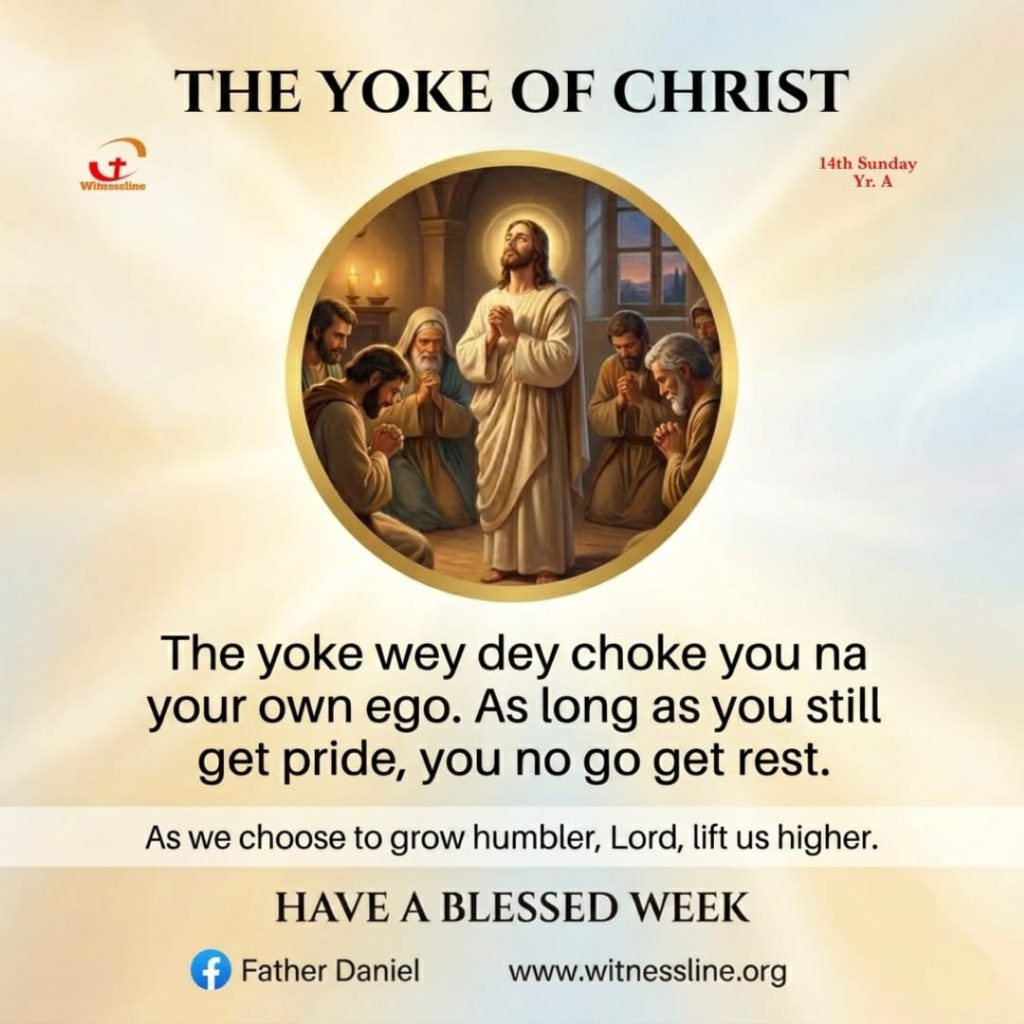
HUMILITY AND REST
Zechariah 9:9-10; Psalm 145; Romans 8:9-11; Matthew 11:25-30
Rev. Fr. Daniel Evbotokhai
Today’s readings revolve around two beautiful and inseparable themes: humility and rest. In a world that glorifies power, self-promotion, competition, and achievement, the Word of God presents a surprising truth: the road to genuine rest is paved with humility. The first reading presents the prophecy of the Messiah entering Jerusalem, not on a war horse as earthly kings would, but riding on a donkey; a symbol of peace and humility (Zechariah 9:9). In the Gospel, Jesus extends one of the most comforting invitations in Scripture: “Come to me, all you who labour and are burdened, and I will give you rest… Learn from me, for I am gentle and humble of heart, and you will find rest for your souls” (Matthew 11:28-29). Notice that Jesus does not merely promise rest; He first invites us to learn humility. According to Christ, humility is not merely a virtue; it is the doorway to interior peace.
Humility is often misunderstood. Many confuse it with weakness, timidity, or low self-esteem. True humility is none of these. Humility is not thinking less of yourself; it is thinking of yourself rightly before God. It is recognizing that every gift, every achievement, every opportunity, and every success ultimately comes from Him (James 1:17). St. Paul reminds us, “What do you have that you did not receive?” (1 Corinthians 4:7). The humble person appreciates his strengths without becoming proud and acknowledges his weaknesses without becoming discouraged.
One uncommon insight is that the Latin word humilitas comes from humus, meaning “earth” or “soil.” To be humble is to remain grounded. Ironically, the tallest trees have the deepest roots. The more grounded you are, greater you become. Likewise, the greatest saints possessed the deepest humility. Pride elevates a person beyond reality, but humility keeps him rooted in the truth. This explains why St. Augustine famously said, “It was pride that changed angels into devils; it is humility that makes men as angels.”
God’s Kingdom Advances Through Humility: The prophecy of Zechariah would have sounded strange to the Jews. They expected a political Messiah who would overthrow Rome with military strength. Instead, God sent a King riding on a donkey. In biblical times, kings rode horses during war but donkeys during times of peace. Christ deliberately chose the donkey because He came not to conquer cities but to conquer hearts. God’s victories are different from worldly victories. The world celebrates dominance, but Heaven celebrates surrender. The world admires those who climb over others; Christ blesses those who stoop to serve others. Every Christian who desires exaltation must first embrace humility, for “God opposes the proud but gives grace to the humble” (James 4:6; 1 Peter 5:5).
Pride: The Hidden Enemy of Rest: One of the greatest obstacles to peace is pride. Pride is subtle. It can hide behind intelligence, wealth, beauty, titles, ministry, education, or even apparent holiness. Pride is not merely thinking highly of oneself; it is living independently of God. Pride whispers, “I can manage without God.” That was the sin of Lucifer (Isaiah 14:12-15), the downfall of Adam and Eve (Genesis 3:5-6), and the tragedy of the Pharisee who exalted himself in prayer (Luke 18:9-14).
A preacher once described pride as both an ENDOPARASITE and an ECTOPARASITE – destroying a person from within while also affecting his relationships with others. Pride isolates because proud people cannot easily apologize, forgive, accept correction, or admit mistakes. Consequently, they lose the very peace they seek. The yoke that is choking many people today is not Satan; it is their ego. We often pray against spiritual yokes while continuing to carry the heavy burden of pride. As long as pride remains, rest will remain distant. Proverbs 16:18 warns us, “Pride goes before destruction, and a haughty spirit before a fall.”
God Reveals Himself to the Humble: Jesus says in today’s Gospel, “You have hidden these things from the wise and learned and revealed them to little ones” (Matthew 11:25). This does not mean that God is against education or scholarship. Rather, He opposes intellectual arrogance. The “wise” here are those who trust only in human reasoning, while the “little ones” are those whose hearts remain open to God’s revelation. Sirach teaches: “The greater you are, the more you must humble yourself; so you will find favour with the Lord” (Sirach 3:18). The Apostles themselves were ordinary fishermen, tax collectors, and labourers, yet through humility they became extraordinary witnesses of Christ. Divine revelation often enters hearts that human pride considers insignificant. Humility empties us so that God may fill us.
The Gift of Rest: The second major theme of today’s Gospel is rest. Jesus invites all who labour and are burdened to come to Him. The burden He speaks about is deeper than physical fatigue. Many people sleep eight hours yet wake up exhausted because their souls remain restless. Anxiety, guilt, fear, competition, comparison, bitterness, and unresolved pain rob the heart of peace. St. Augustine beautifully expressed this universal experience when he wrote: “Our hearts are restless until they rest in You.” Every human being longs for rest, yet many search for it in money, pleasure, fame, social media, alcohol, unhealthy relationships, or endless entertainment. Unfortunately, these provide distraction rather than rest.
Christ alone offers rest for the soul, the deepest kind of peace. This is why Isaiah declares, “You keep him in perfect peace whose mind is stayed on You” (Isaiah 26:3). Likewise, St. Paul assures us, “The peace of God, which surpasses all understanding, will guard your hearts and your minds in Christ Jesus” (Philippians 4:7).
Sleep Is Also God’s Gift: Physical rest should not be neglected. In our highly connected generation, many sacrifice sleep for endless scrolling, binge-watching, or social media engagement. Yet Scripture reminds us that “He gives sleep to His beloved” (Psalm 127:2). Sleep is not laziness; it is God’s design for restoring the body and renewing the mind.
Medical science increasingly confirms what Scripture has always taught: proper rest strengthens the immune system, improves emotional stability, sharpens decision-making, and promotes overall well-being. While every emotional or psychological illness should never be simplistically attributed to lack of sleep, chronic stress, anxiety, and exhaustion can worsen many mental and physical conditions. Therefore, working hard must always be balanced with adequate rest. Even Jesus, after intense ministry, withdrew to lonely places to pray and rest (Mark 6:31).
Take Christ’s Yoke:Jesus concludes by saying, “Take my yoke upon you.” To modern ears, a yoke sounds like a burden. Yet in Jewish tradition, a yoke symbolized discipleship; the acceptance of a master’s teaching and way of life. Every person carries a yoke. Some carry the yoke of sin, addiction, greed, lust, resentment, or ambition. Christ does not promise a life without responsibility; He offers a lighter yoke because He carries it with us.
Christ’s yoke is light because it is sustained by grace. Satan’s yoke enslaves; Christ’s yoke liberates; e no dey choke. Pride exhausts; humility refreshes. Sin burdens; grace restores.
LET US PRAY
O God, who in the humility of your Son raised up our fallen world, deliver us from the burden of pride and teach us the gentleness of Christ. Grant that, bearing His easy yoke with joyful hearts, we may find true rest in this life and eternal rest in your heavenly kingdom. Through Christ our Lord. Amen.
